Grooming Guide

Groomie Shaver: A Closer Look at the Head & Body Shaver Everyone's Asking About

Choosing an electric shaver isn't just about price — it's about how it treats your skin, how long it lasts, and whether it actually keeps up with your routine. This guide breaks down the Groomie Shaver's design, features, and real trade-offs so you can decide if it fits your grooming habits.

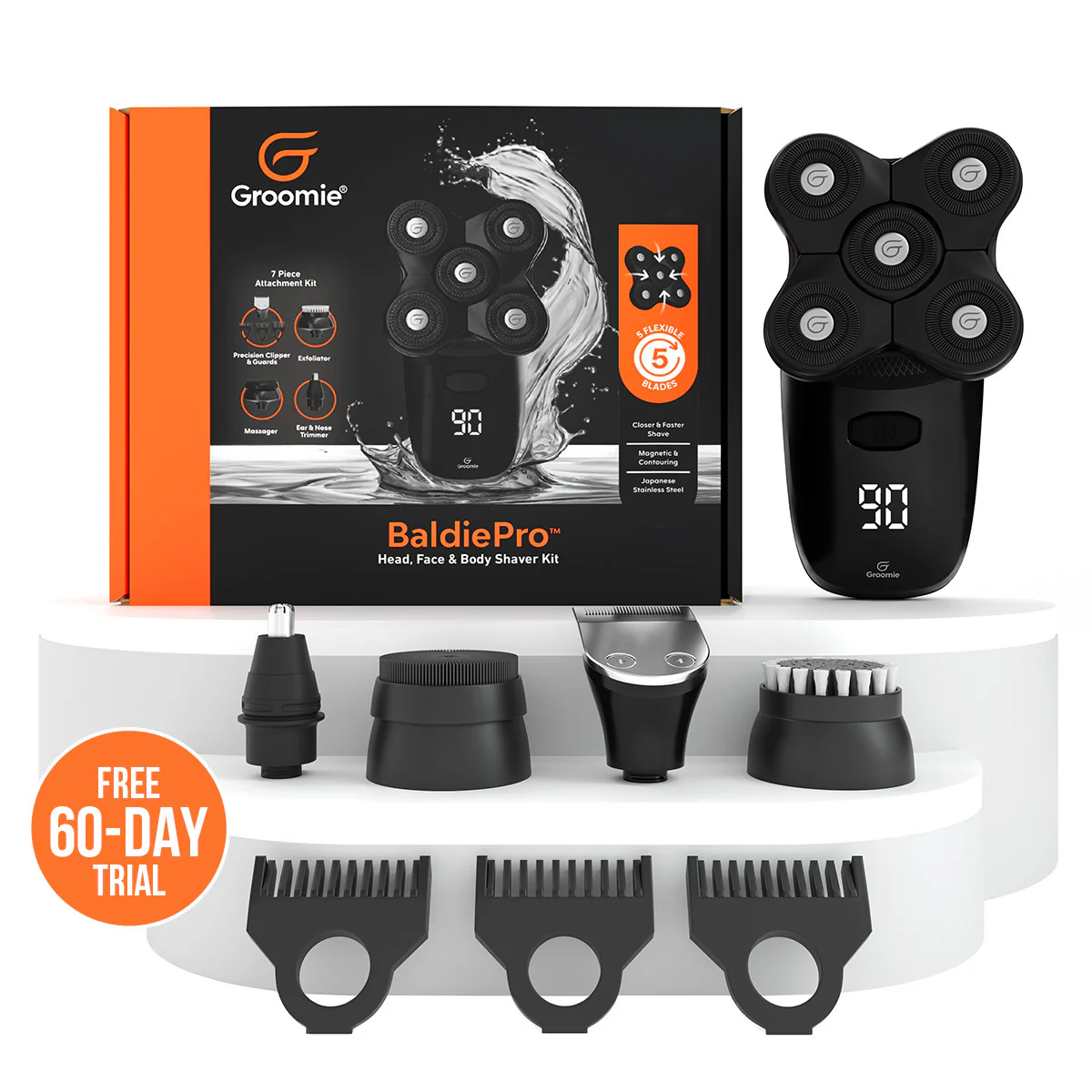
Groomie Shaver electric head and body shaver kit displayed with its full set of grooming attachments

Introduction

What Is the Groomie Shaver?

The Groomie Shaver is a rechargeable, rotary-blade electric shaver built primarily for shaving the head, though it's designed to work across the chest, legs, and other body areas as well. It's part of a growing category of multi-use groomers that try to replace a drawer full of separate tools — razors, trimmers, and body groomers — with a single rechargeable unit.

Where It Fits

Traditional safety razors are cheap but require replacement blades, shaving cream, and a steady hand to avoid nicks. Standard electric shavers solve some of that, but many struggle on curved areas like the scalp or don't hold up well to water. The Groomie Shaver is positioned as a middle ground: a cordless rotary shaver that can be used wet or dry, with a blade system designed to glide over contours rather than catch on them.

Whether it's genuinely worth adding to your routine depends on your skin type, how often you shave, and how much you value convenience versus a traditional close shave — all of which we'll walk through below.

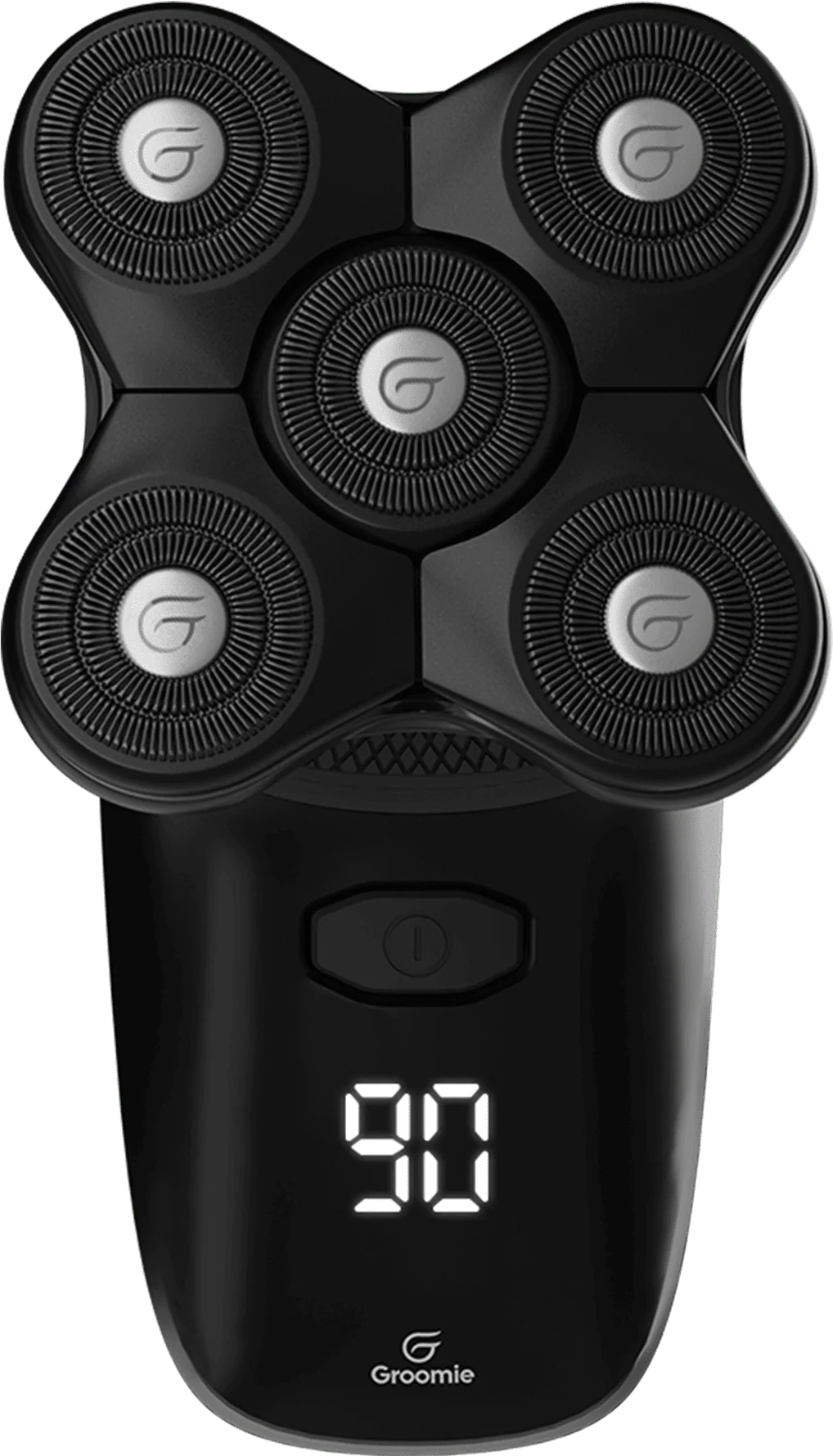
Close-up of the Groomie Shaver rotary blade head showing its design for head and body shaving

At a Glance

Quick Overview

Shave Type

Wet & dry, rotary blade system for head and body use.

Power Source

Rechargeable lithium battery with USB charging.

Water Resistance

Shaver body rated for wet use — charging components are not.

Included Attachments

Guide combs, precision trimmer, and skin-prep accessories.

Best Suited For

Head shaving, with secondary use on chest, legs, and body hair.

Maintenance

Rinse-clean blade head; periodic blade replacement recommended.

Under the Hood

Why This Shaver Stands Out

Most of what separates a good electric shaver from a mediocre one comes down to three things: how the blade contacts skin, how much control you have over pressure and angle, and how it handles moisture. Here's how the Groomie Shaver approaches each.

  • Contour-following head: the rotary blade design is meant to flex slightly against curves like the scalp, rather than forcing you to flatten skin against a rigid foil.
  • Wet or dry flexibility: it can be used in the shower with water and shaving gel, or dry for a faster, no-mess routine — a genuine point of difference from shavers that are dry-only.
  • Ergonomic grip: the handle shape is built so you can reach awkward spots (back of the head, jawline) without straining your wrist.
  • Faster sessions: a full head shave typically takes a few minutes once you're used to the angle and pressure it needs.

None of this replaces good technique. Even the best rotary shaver will tug on longer hair, so most users get the smoothest result by trimming hair down first, then following up with the shaver for a closer finish — the same two-step approach barbers use with clippers and razors.

Under the Hood, In Depth

The Full Mechanism: Every Component and What It Actually Does

Marketing copy tends to describe shavers in terms of adjectives — "smooth," "powerful," "precise." What's actually happening is a small stack of well-understood engineering systems working together: a cutting mechanism, a motor, a power cell, a sealed housing, and an interface with your skin. Understanding each of these on its own terms is the only way to judge whether a shaver like this is actually well-built, rather than just well-marketed.

Component 1

The Cutting System — Rotary Blade Heads

A rotary shaver head is built around two cutting elements moving against each other: an outer guard with slotted or angular openings, and an inner cutter that spins beneath it. Hair enters through the openings in the guard, and the spinning inner blade shears it off close to the skin — a design patent literature describes as a cutter tube with cutting-edge apertures rotating against a fixed blade so hair is sheared between the two surfaces rather than pulled. Because the guard sits between the spinning blade and the skin itself, the blade edge never contacts skin directly, which is the core mechanical reason rotary heads are generally gentler than an exposed razor edge.

Most rotary shavers, this one included, arrange multiple circular heads (commonly two to four) in a cluster so the unit can flex slightly and follow the curve of a scalp, jaw, or knee rather than requiring a flat cutting angle. This flexing action is what lets a single pass cover a curved surface that a rigid straight blade would miss in sections.

Sources: Freebird — Foil vs. Rotary Shavers, Shavers.co.uk — How Rotary Shavers Work

Component 2

The Drive Motor

The motor is what converts stored electrical energy into the rotational force that spins the cutter heads. In a rotary shaver, torque matters as much as raw speed: the motor has to keep the blades spinning at a consistent rate even as hair density and pressure change moment to moment, or the shave becomes uneven and can tug rather than cut cleanly. This is why higher-quality shaver motors are usually paired with some form of load-sensing or torque regulation, so the blades don't bog down on thicker patches of hair.

In practical terms, the motor's job is simple to state and hard to execute well: hold a stable rotational speed under a variable, unpredictable load, for the several minutes a full head shave takes, without overheating the housing around it.

Component 3

The Power Cell — Lithium-Ion Battery

Cordless shavers run on rechargeable lithium-ion cells, the same battery chemistry used in phones and laptops. Inside the cell, a cathode and an anode are separated by an electrolyte and a thin porous separator. During use, lithium ions move from the anode to the cathode through the electrolyte, and the electrons that are freed by that movement travel through the external circuit — the motor — which is what actually powers the blades. Charging simply reverses the process, driving the ions back to the anode so the cycle can repeat.

This chemistry is why two care habits genuinely matter, and aren't just generic advice: avoiding continuous overcharging, and avoiding letting the cell sit fully drained for long periods. Both extremes accelerate the gradual capacity loss that all lithium-ion cells experience over hundreds of charge cycles.

Sources: U.S. Department of Energy — How Lithium-ion Batteries Work, Ossila — Lithium-Ion Battery Components and Working Principle

Component 4

The Waterproof Housing — IPX7 Sealing

A shaver rated IPX7 has passed a specific, standardized test under IEC 60529, the international Ingress Protection standard: full immersion in up to one meter of water for around 30 minutes, with no harmful water ingress to the internal components afterward. That "X" in the middle of the rating isn't a typo — it means the solid-particle (dust) protection level simply wasn't tested for this class of product, only the liquid protection was rated.

Achieving that rating in a shaver means the seams around the blade head, the button, and the battery compartment all rely on rubber gaskets or O-rings compressed tightly enough to block water while the unit is fully submerged. It's important to understand what the rating does not cover: charging ports, USB adapters, and external cables are typically excluded from the sealed enclosure, which is exactly why manufacturers warn against charging a shaver in a wet bathroom environment.

Sources: Wikipedia — IP Code (IEC 60529), Applus+ Keystone — IPX7 Ingress Protection Testing

Component 5

The Skin-Contact Interface — Why Head Design Affects Irritation

The reason head shape and blade distance from skin get so much attention isn't cosmetic — it connects directly to a well-documented dermatological condition called pseudofolliculitis barbae, more commonly known as razor bumps. Dermatology references describe it as an inflammatory, foreign-body reaction that occurs when a freshly cut hair tip curls back and re-enters the skin, either before it fully exits the follicle or shortly after emerging from it. This is especially common with tightly coiled or coarse hair, and it's driven mechanically by how close and how sharp the cut is at skin level.

Single- and multi-blade razors that cut hair flush with (or slightly below) the skin surface leave a sharpened tip positioned to curl back in. Rotary shavers, by design, keep the cutting edge slightly elevated behind a guard, which generally leaves a blunter, less severe cut and reduces — though doesn't eliminate — the mechanical conditions that lead to ingrown hairs. This is a genuine, evidence-based reason some dermatology resources note electric razors as one option for people prone to razor bumps, though technique (light pressure, not stretching the skin taut, shaving with rather than against the grain) still matters more than the tool itself.

Sources: DermNet NZ — Pseudofolliculitis Barbae, Merck Manual — Pseudofolliculitis Barbae

Note: the mechanical and biological principles above are general engineering and dermatology knowledge that applies to rotary shavers and shaving-related skin reactions as a category. They describe how this type of product works and why irritation happens in general — they aren't a substitute for the manufacturer's own published specifications, nor for a dermatologist's evaluation of your specific skin.
Everyday Use

What Does the Groomie Shaver Do for You?

Beyond the spec sheet, here's what actually changes in your routine once you swap to a rotary head-and-body shaver like this one.

If you currently shave your head with a disposable razor, the biggest shift is skipping the nick-and-irritation cycle that comes with dragging a blade directly across the scalp. A rotary shaver rides slightly above the skin surface, which lowers (though doesn't eliminate) the risk of razor bumps, especially if you have sensitive skin or a tendency toward ingrown hairs.

The all-in-one attachment set also means fewer separate purchases — a guide comb for trimming length before a full shave, a precision head for lining up edges around ears or a beard, and a body-safe head for chest or leg hair. For anyone who currently owns three or four separate tools for these jobs, consolidating into one rechargeable unit is a genuine convenience win, not just marketing language.

Cordless operation matters more than it sounds: no fumbling with a cord in the shower, and no being tied to an outlet mid-shave. Battery life is the trade-off to watch — like any rechargeable tool, output slows as the battery ages, so how you charge and store it affects how long it stays reliable.

It's not a miracle solution. If you have very coarse or long hair, expect to trim first. If you have very reactive, easily-irritated skin, patch-test on a small area before committing to a full head shave, wet or dry.

Balanced View

Pros and Cons

Pros

  • Works wet or dry — flexible for shower or quick countertop use
  • Cordless and rechargeable, easy to travel with
  • Rotary head designed to follow the curve of the scalp
  • Comes with multiple attachments in one kit
  • Rinseable blade head makes cleanup simple

Cons

  • Charging cable and adapter are not water-safe — only the shaver body is
  • Long or very coarse hair needs a trim first for best results
  • Battery performance will gradually decline with age, like any lithium battery
  • Blade head needs periodic replacement to keep shaves close

Customer Feedback

Groomie Shaver Reviews Summary

Rather than cherry-pick individual quotes, here's a general summary of the themes that come up most often in buyer feedback and grooming-product forums.

4.3
★★★★☆

Typical feedback theme

Comfort on scalp
Ease of use
Battery life
Value for money

These figures reflect commonly reported buyer sentiment on convenience and comfort rather than a certified independent lab study. As with any grooming tool, individual results vary by skin type and hair texture.

The Bigger Picture

Why Consider the Groomie Shaver

There's no shortage of electric shavers on the market, so it's fair to ask what actually justifies choosing this one over a basic foil shaver or a disposable razor.

Packages

Groomie Shaver Price, Packages and Bonuses

Pricing on multi-attachment electric shavers usually drops per unit when you buy more than one, since it spreads shipping and packaging costs. Always confirm current pricing on the official order page before purchasing, as promotions change.

PackageWhat's IncludedBest For
Single Unit 1 Groomie Shaver + standard attachment set First-time buyers trying it out
Two-Pack Popular 2 Groomie Shavers, shared accessory set, small per-unit discount Sharing with a partner or backup unit
Three-Pack + Bonus Accessories 3 Groomie Shavers, full accessory bundle, extra guide combs Households or gifting to family

See current pricing and package details on the official order page.

Money-Back Guarantee

Most official Groomie Shaver orders are backed by a 30-day return window if the product doesn't work out for you. Keep your order confirmation and original packaging, and check the exact terms listed on the order page, since return policies can be updated by the seller at any time.

Honest Advice

What to Take Care of Before Buying

A grooming tool is a personal purchase — what works well for one person's skin and hair won't necessarily suit another's. Before you buy any electric shaver, Groomie included, go through this checklist.

1

Check your skin sensitivity

If you have a history of razor bumps, eczema, or reactive skin, patch-test on a small area first, wet and dry, before doing a full head or body shave.

2

Trim long hair first

Rotary shavers work best on short-to-medium hair. If your hair is longer than a guard length, trim it down before shaving for a cleaner result and less strain on the motor.

3

Keep the charger away from water

The shaver body may be rinseable, but charging cables and adapters typically are not. Never charge the unit in a bathroom near a running shower or sink.

4

Plan for blade replacement

Like any shaver, the blade head dulls over time. Factor the cost and availability of replacement heads into your decision, not just the upfront price.

5

Buy from the official source

Electric shavers are commonly counterfeited on third-party marketplaces. Order from the official page to make sure you're covered by the actual warranty and return policy.

6

Read the current return policy yourself

Promotional terms and guarantee windows can change. Don't rely on secondhand summaries — check the live order page before you buy.

Common Questions

Groomie Shaver FAQs

How long does a Groomie Shaver typically last?

A Groomie Shaver typically lasts for several years when it's cleaned after use and stored properly. The blade head is the part that wears out first, so replacing it periodically is what keeps the shave close over that lifespan.

How do I clean the Groomie Shaver?

To clean the Groomie Shaver, turn it off, unplug it from any charging cable, rinse the blade head under running water if it's rated for wet cleaning, and let it air dry fully before storing it, keeping the charging port dry.

Do I need to charge the Groomie Shaver before every use?

You don't need to charge the Groomie Shaver before every single use, but it does need periodic recharging like any battery-powered device — it's best not to leave it plugged in continuously for extended periods, since that can shorten lithium battery lifespan over time.

Can teenagers use a Groomie Shaver?

Teenagers can use a Groomie Shaver, since electric shavers are generally considered lower-risk than blade razors — though anyone new to shaving, teens included, should start slowly, use a light touch, and consider adult supervision or guidance the first few times.

Can I use the Groomie Shaver on areas other than my head?

You can use the Groomie Shaver on areas other than your head — most head shavers in this category, including this one, are also marketed for chest, leg, and other body hair, though results and comfort can vary depending on skin sensitivity in those areas.